
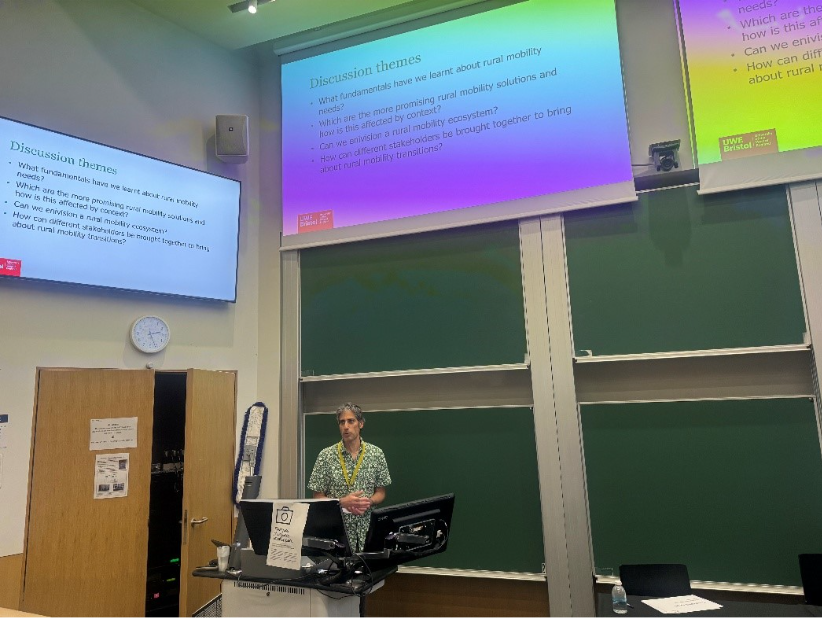
The DRT project team was at the Royal Geographical Society Annual International Conference in London at the start of September. Eda Beyazit and Kiron Chatterjee organised a double session of presentations on the theme of ‘Reimagining rural mobility’. The presentations explored the transport challenges facing rural areas and the contribution of DRT and other potential solutions.
To reimagine rural mobility, we first need to understand it better. Xavier Bach (Institut Metròpoli) showed how this can be done through a travel survey which covered the city of Barcelona and surrounding rural area. Analysis of the data showed dominance of car travel in rural areas with vulnerable social groups relying on lifts. Xavier suggested ‘30 minute territories’ as a goal for rural areas given 15-minute cities are not a realistic ambition.
Living in a rural area can cause increasing difficulties as one gets older. This was evident from two presentations focused on Aotearoa New Zealand. Angela Curl (University of Otago) found a tendency for adults over 50 in the South Island to move away from areas with good accessibility to healthcare to areas with poorer accessibility. To add to this, Rebecca McLean (University of Otago) reported results from a cohort study of older drivers which showed those who stopped driving became reliant on the support of family and friends and reduced their out-of-home activities. The two presentations highlighted the need for services to be provided where they are needed in rural areas and for targeted mobility support.
Our research team gave two presentations based on our DRT research. Daniel Johnson (University of Leeds) reported on trips that could not have been made by DRT users without DRT and the social value of the activities enabled as a result. Eda Beyazit (UWE Bristol) emphasised the significance of DRT is more than the additional activities that people can access – interviews revealed how DRT enables its users to have more autonomy and sociality in their lives.
Lars Olsson (Karlstad University) looked at Swedish DRT users and the importance of the quality of the service. Lars found that it is only when users are highly satisfied with the service that they can perform desired activities and live life as they wish. This highlights the need for providers to meet the service needs of its users.
Three presentations looked at future mobility solutions. Hannah Budnitz (University of Oxford) explored shared electric vehicles which have the potential to contribute both to decarbonisation and to widening access to transport in rural communities. Hannah described examples of operating models of schemes that have been set up across England. Jenny Milne (University of Aberdeen) has researched the potential for combining people and goods movements as a Rural Mobility as a Service (RMaaS4PP). Jenny conducted a survey of visitors to Cairngorm National Park and Lake District National Park and found many visitors willing to collect and drop off small parcels or prescriptions on their journeys in the area. Melissa Evans (researcher anthropologist) drew from a variety of examples to highlight that rural mobility challenges require more than transport solutions and often need systemic changes, including multi-agency collaboration and policy reform.
We were pleased to have been able to bring together such a diverse set of presentations and share ideas to help achieve more socially just mobility in rural communities.